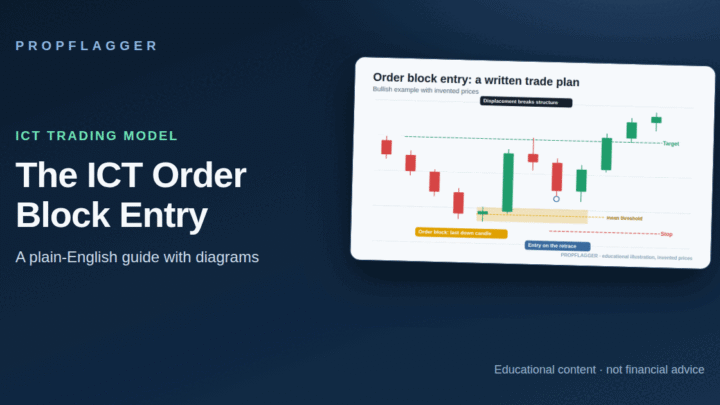
ICT Order Block Entry Explained: The Last Opposite Candle
An order block is the last opposite candle before a strong move. I compare the ways to draw it and explain how I would plan an entry around…

An educational trading journal documenting my approach to intraday trading, strategy research, chart analysis, and lessons learned.
Explore Journal Read the Blog Explore Strategies →
Educational content only — no signals, no guarantees, no financial advice.
An order block is the last opposite candle before a strong move. I compare the ways to draw it and explain how I would plan an entry around…
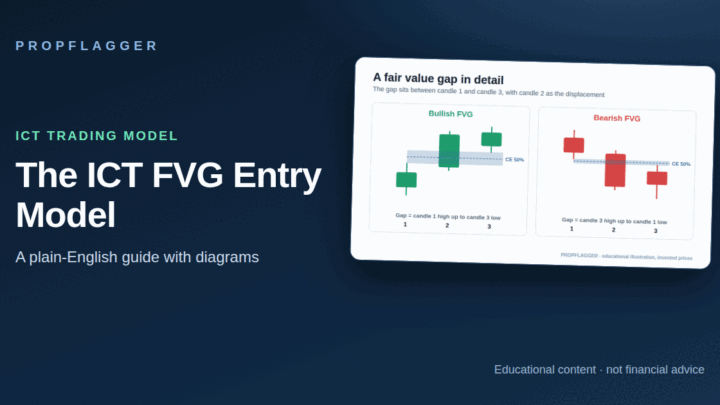
A fair value gap is the space between the wicks of candles one and three. I show how to draw it, where the 50% level sits and where…

A breaker is an order block that failed and is retested from the other side. I explain how it forms and what makes it different from a plain…
Public journal entries will appear here.
My journal documents my own trades and decisions. Your results may be different.
ICT-201 Active
Buy-side liquidity (a marked high) is swept and fails to hold. Price displaces downward and closes below a lower-timeframe swing low. The gap or order block left by that move is marked, and the entry is planned on the retracement into it, with the stop above the sweep.
ICT-210 Active
A bullish order block (or swing low) is broken after a sweep of a high and a structure shift down. The old block is retested from below as resistance (a bearish breaker), and the entry is a limit at or near it, with the stop above its far edge.
ICT-205 Active
A bearish gap forms after downward displacement, ideally following a sweep of a high and a bearish structure shift. The entry is a limit inside the gap (often at the CE), with the stop above the gap or the first candle’s high.
Annotated chart breakdowns and walk-throughs.
Where resting orders sit, how liquidity is taken and what it can mean for price.
Swing highs and lows, trends, ranges and changes of character.
Reading candles, zones and reactions on the chart.
Position sizing, stop-loss placement, R multiples and protecting capital.
Foundational explanations of how markets and intraday trading work.
What my own journal entries — wins, losses and mistakes — have taught me.
Discipline, emotions, habits and decision-making under uncertainty.
Educational write-ups of the frameworks I study and journal.
Charting platforms, spreadsheets and routines I use for study and journaling.
PropFlagger
One short email when I publish something new: strategy notes, chart breakdowns and journal reviews. No signals, no spam, unsubscribe any time.