

Trading Psychology

Trading Psychology Explained: Loss Aversion, FOMO and Revenge Trading

Why losses feel bigger than gains, how FOMO and revenge trading start, and simple rules that protect you from your own reactions.

Trading Psychology Explained: Loss Aversion, FOMO and Revenge Trading (featured illustration)

Quick answer

Trading psychology is the study of how emotions and mental shortcuts affect trading decisions. Key effects include loss aversion (losses feel about twice as painful as equal gains feel good), the disposition effect (selling winners too early and holding losers too long), FOMO and revenge trading. Written rules, small position sizes, daily loss limits and a journal reduce their influence.

Key takeaways

  • Losses typically feel larger than equal gains (loss aversion).
  • Investors tend to sell winners early and hold losers (the disposition effect).
  • FOMO and revenge trading break your own rules; both can be limited with pre-set limits.
  • Think in probabilities: any single trade can lose even when the plan is sound.

What is trading psychology?

Trading psychology is how your emotions, habits and mental shortcuts shape your trading decisions. Two traders with the same strategy and the same chart can end with different results because they behave differently at the moment of decision.

This guide covers the best-documented effects and the practical rules that help. It is educational, not therapy or financial advice.

Why does a loss hurt more than a gain feels good?

In their 1979 paper on prospect theory, Daniel Kahneman and Amos Tversky showed that people judge outcomes as gains or losses from a reference point, and that losses weigh more heavily than equal gains. This is called loss aversion. Studies often estimate the loss side to be roughly twice as steep as the gain side, although the exact number varies.
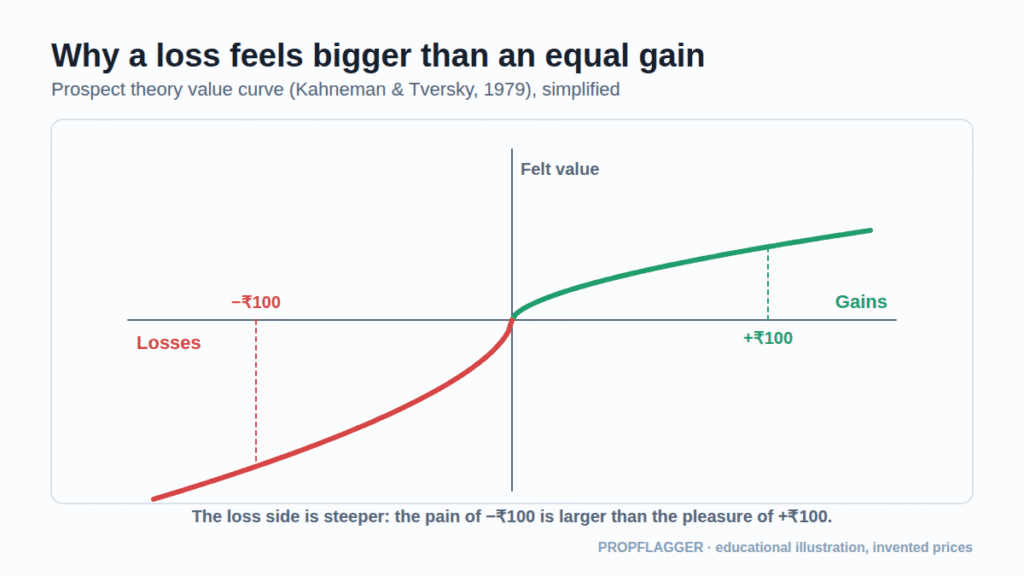
Prospect theory value curve showing losses steeper than gains
The prospect-theory value function: the loss side is steeper than the gain side.

For traders, that means the sting of a −₹100 loss can be bigger than the pleasure of a +₹100 win. Effects include:

  • Closing winning trades too early to avoid giving back profit.
  • Moving or removing a stop-loss to avoid taking a loss.
  • Avoiding the next valid setup after a loss.

What is the disposition effect?

The disposition effect is the tendency to sell winners too soon and hold losers too long. Terrance Odean (1998) analysed thousands of brokerage accounts and found that investors were more likely to sell stocks that had gained than stocks that had lost, even when that did not help them. It is a good example of why a written exit plan matters.

What are FOMO and revenge trading?

  • FOMO (fear of missing out): you enter late because price is moving fast and others seem to profit. The entry has no plan and usually a poor stop.
  • Revenge trading: after a loss you want to win it back, so you trade bigger or without a setup.
  • Overtrading: trading because you are bored or want action, not because a setup appeared.
  • Overconfidence: a few wins make you feel that the rules no longer apply.
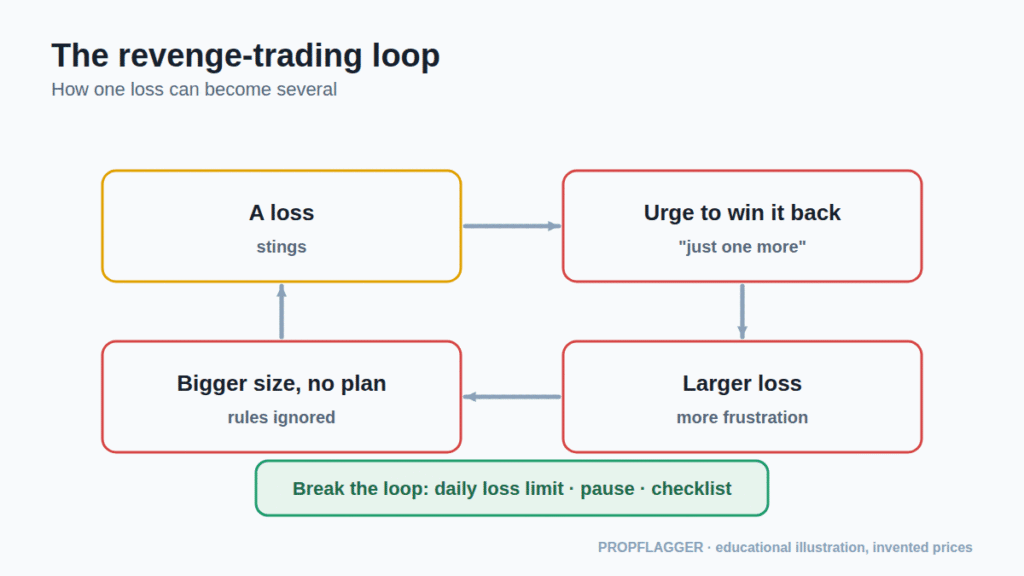
Loop diagram: a loss, the urge to win it back, bigger size without a plan, a larger loss, and a way to break the loop
How a single loss can turn into several.

How do you think in probabilities?

In Trading in the Zone, Mark Douglas argues that consistency begins with accepting uncertainty. Paraphrasing his five ideas: anything can happen; you do not need to know what happens next to make money; wins and losses are randomly distributed for any given setup; an edge is only a higher probability, not a certainty; and every moment in the market is unique.
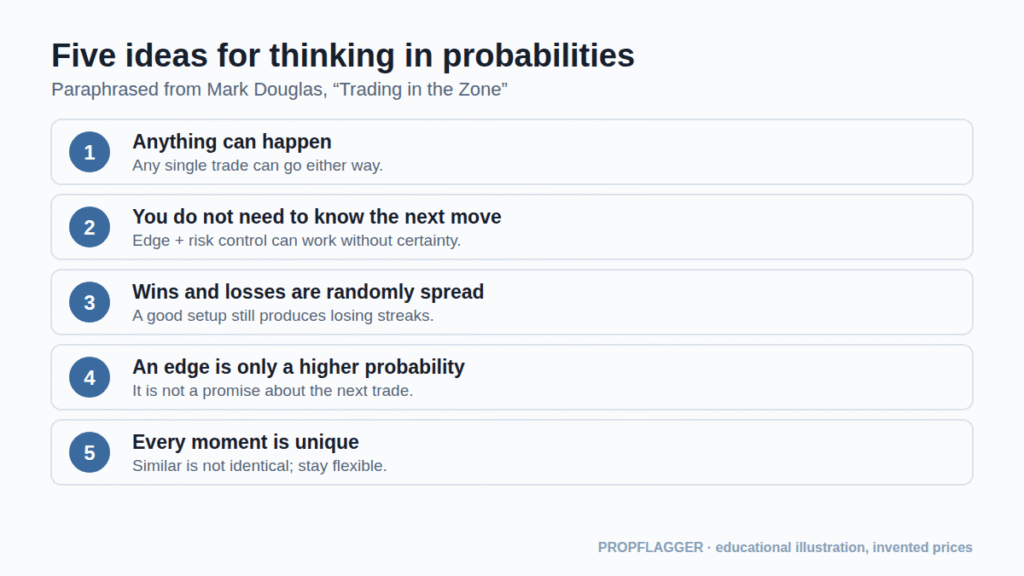
Five ideas for thinking in probabilities paraphrased from Mark Douglas
Five ideas for thinking in probabilities.

The practical point: judge a trade by whether you followed your plan, not by whether it won. Over a large number of trades, a sound plan with controlled risk is what matters.

What rules protect you from your own reactions?

Problem and practical countermeasure
Problem Practical rule
Moving stops Stops may only be moved in the direction of reducing risk.
Revenge trading After two losses or a −2R day, stop and step away.
FOMO No entry unless every checklist item is present.
Overtrading Maximum number of trades per day.
Oversizing Risk a fixed small percentage (see risk management).

How can a journal help?

Add an “emotion” field to every journal entry and a “plan followed?” tick. After a month you will see whether anger, rush or boredom show up in your worst trades. That evidence is more convincing than any advice. See how to keep a trading journal.

When should you take a break?

Step away after a larger-than-planned loss, a rule violation, a stressful event outside trading, or a streak that makes you feel invincible. Trading again tomorrow costs nothing; trading angry can cost a lot. If trading is causing real distress, consider talking to a professional.

Educational content only. Research findings describe tendencies, not individuals. Trading involves substantial risk of loss.

Key terms

Loss aversion
The tendency to feel losses more strongly than equivalent gains.
Disposition effect
Selling assets that have gained too soon and holding assets that have lost too long.
FOMO
Fear of missing out: entering because price is moving, not because your plan says so.
Revenge trading
Trading impulsively to recover a recent loss.

Frequently asked questions

What is loss aversion in trading?

Loss aversion is the finding that people feel the pain of a loss more strongly than the pleasure of an equal gain. In trading it can make you cut winners early to “lock in” a gain and hold losers hoping they recover.

What is revenge trading?

Revenge trading is taking impulsive, often larger trades right after a loss in an attempt to win the money back. It usually ignores the plan and risk limits, which is why many traders set a daily loss limit and take a break after a stop-out.

How do I stop trading emotionally?

You cannot remove emotion, but you can limit its effect: write rules before the session, use a pre-trade checklist, keep risk small, set a daily loss limit, and record your emotions in a journal so patterns become visible.

What is FOMO in trading?

FOMO is the fear of missing out. It shows up as chasing a move that has already happened, entering without your setup, or oversizing because everyone seems to be making money. A rule such as “no entry without my checklist” counters it.

Does trading psychology guarantee profits?

No. Good discipline protects you from avoidable mistakes, but it does not create an edge. You still need a tested approach, controlled risk and the acceptance that losses are part of the process.

Sources and further reading

  1. Kahneman & Tversky (1979), Prospect Theory: An Analysis of Decision under Risk, Econometrica
  2. Odean (1998), Are Investors Reluctant to Realize Their Losses? Journal of Finance
  3. Bookmap: the five truths of trading (summary of Mark Douglas)

External links open in a new tab. They are provided for reference and are not endorsements.

Last reviewed: . Written by the PropFlagger editor for education. Diagrams use invented prices. Nothing here is financial advice or a recommendation to trade.

Tags:

Join the discussion

Your email address will not be published. Required fields are marked *

Comments are moderated. Please do not post trade signals, tips, links to paid groups, or claims of guaranteed returns.