

What does the data say about beginner traders?
Before any technique, it helps to know the starting odds. The Securities and Exchange Board of India (SEBI) studied the profit and loss of individual traders in equity futures and options (F&O):
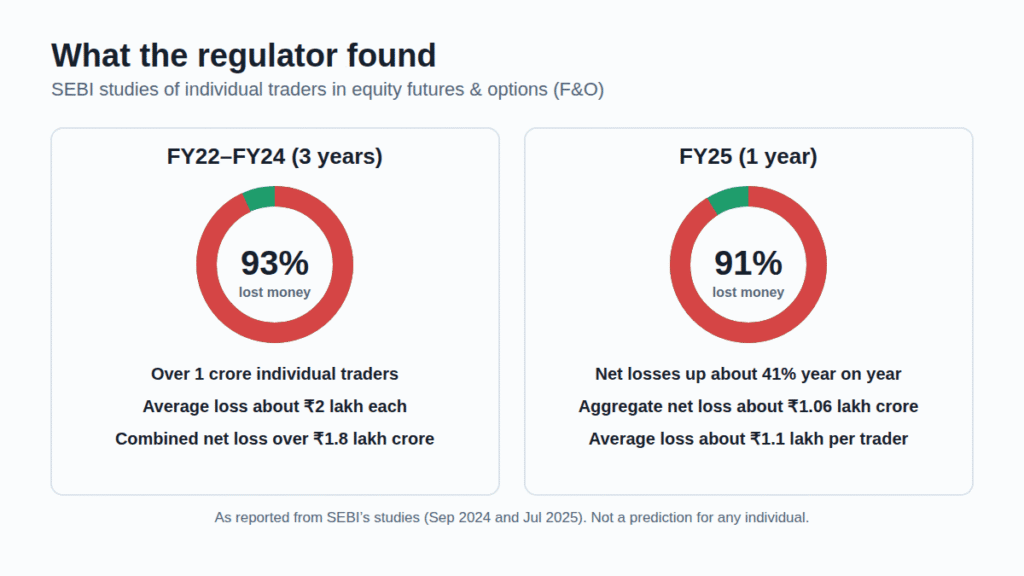
- FY22–FY24: over 93% of more than one crore individual traders had net losses, averaging about ₹2 lakh each including transaction costs. Combined net losses exceeded ₹1.8 lakh crore.
- FY25: about 91% had net losses; aggregate net losses rose about 41% to roughly ₹1.06 lakh crore, with an average of around ₹1.1 lakh per trader.
These figures cover one segment of one market, but the message generalises: trading profitably after costs is difficult, and most people who try it lose money. That does not mean you should not learn. It means you should learn carefully and cheaply.
What is the best order to learn trading?
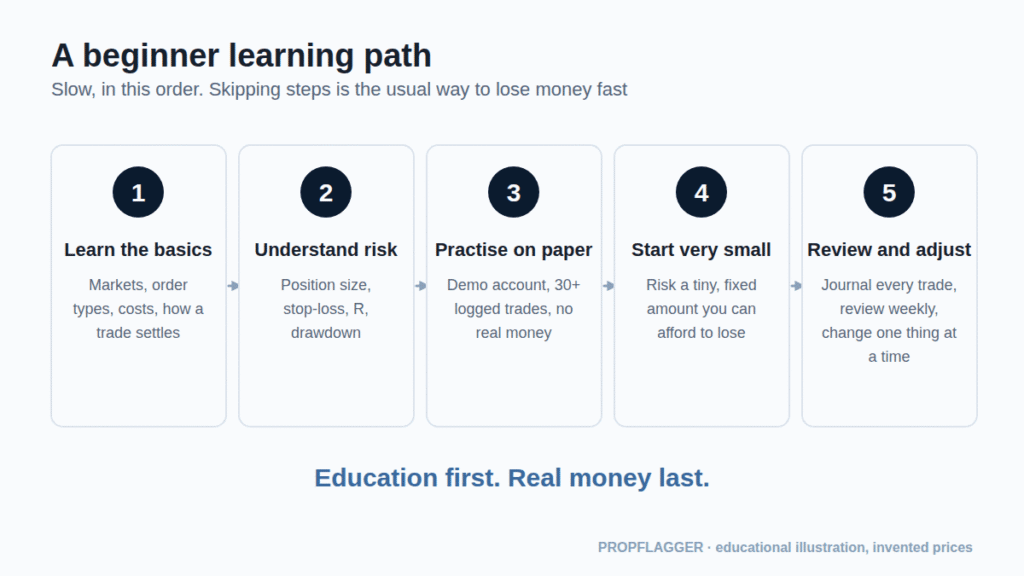
- Learn the basics. Exchanges, order types (market, limit, stop), margin, brokerage and taxes, settlement, and how a trade is recorded.
- Understand risk. Position sizing, stop-loss, R-multiples and drawdowns. Read the risk management guide before anything about entries.
- Learn to read charts. Candles, trend, levels and timeframes (chart analysis, market structure, price action).
- Practise on paper. Use a demo or paper account and log at least 30 trades.
- Start very small. If you trade real money, use an amount you can afford to lose entirely, and a fixed small risk per trade.
- Review every week. Process first, outcome second.
Where can you learn for free?
- Regulator and exchange resources. SEBI launched the free, voluntary SEBI Investor Certification Examination (SICE), developed with NISM, covering markets, risks and investor protection.
- Broker education sections and exchange academies explain order types, margin and products.
- Your own trade records. A journal is the most personal textbook you will ever have.
Is paper trading worth it?
Paper trading, trading with simulated money on real prices, is a safe way to learn a platform and test whether you can follow a plan. It has limits: fills are idealised, and you do not feel the stress of real loss, so results usually flatter you. Use it to prove you can follow rules, not to prove you will make money.
How do you judge a trading course or mentor?
Treat these as red flags:
- Guaranteed or “assured” returns.
- Selling tips, calls or signals without being a registered adviser or research analyst. In India you can verify registration with SEBI.
- Screenshots of a few winning trades but no full record, no losses, no costs.
- Urgency: “limited seats”, “join today or miss out”.
- No explanation of risk.
A trustworthy educator shows losing trades, explains risk first and does not ask you to rely on them for decisions.
Why does learning keep going after the course?
Skill in trading is built by repeating a loop: plan, trade, record, review.
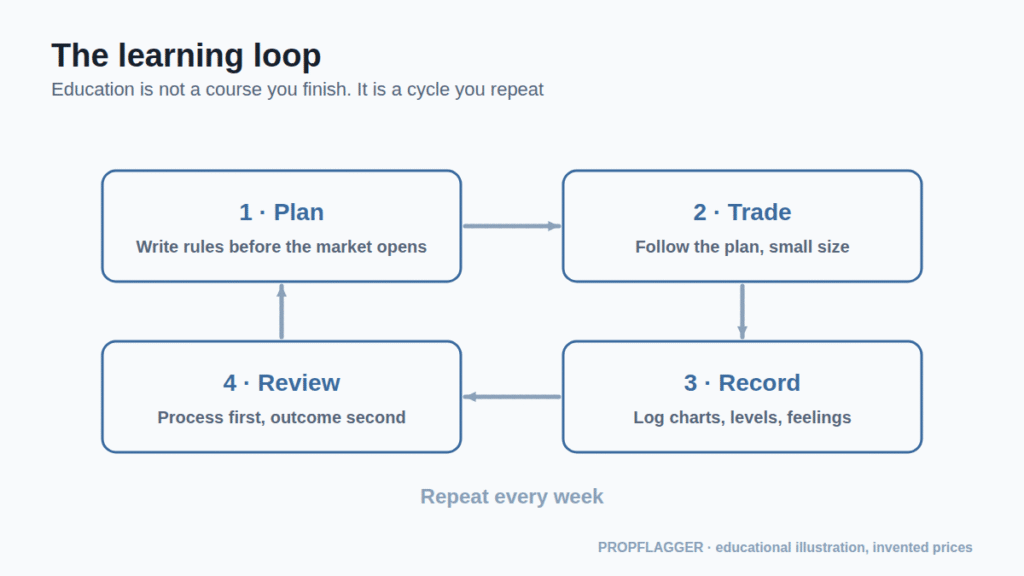
Keeping a record of each trade turns every outcome, good or bad, into information. See how to keep a trading journal.
What about the emotional side?
Most beginner mistakes are behavioural: oversizing, chasing, refusing to take a planned loss. Learning about trading psychology early helps you recognise them in yourself.
Educational content only. This page is not investment advice and does not recommend any product or service. Trading involves a substantial risk of loss.