


No claims, no guarantees. These are my personal study notes, written for education. I am not claiming that this model works, that it is profitable or that it will work for you. Nothing here is financial advice, a signal or a recommendation to trade. Trading carries a substantial risk of loss, and most retail traders lose money. See the full disclaimer.
What is the ICT Silver Bullet?
The Silver Bullet is the model I find easiest to audit, because the clock does half the work. It is a fair value gap entry that I am only allowed to take inside one of three one-hour windows. It is one of the twelve models in my ICT research notes, and a time-boxed cousin of the 2022 Model.
When are the three windows?
All three are in New York time: 3–4 AM (London), 10–11 AM (New York morning) and 2–3 PM (New York afternoon). Because the US changes its clocks, the IST equivalent moves by an hour twice a year.
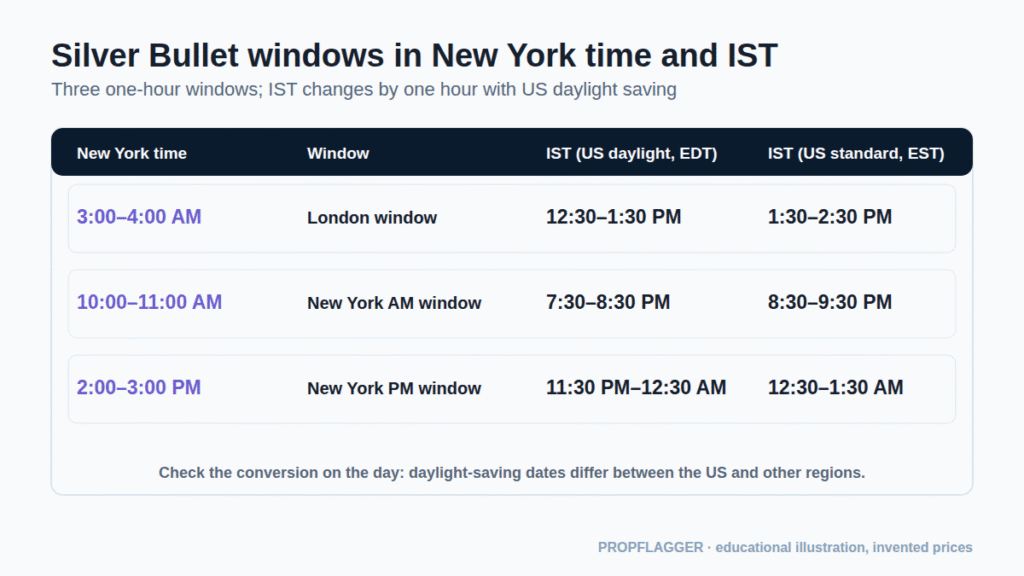
| New York time | IST (EDT) | IST (EST) |
|---|---|---|
| 3:00–4:00 AM | 12:30–1:30 PM | 1:30–2:30 PM |
| 10:00–11:00 AM | 7:30–8:30 PM | 8:30–9:30 PM |
| 2:00–3:00 PM | 11:30 PM–12:30 AM | 12:30–1:30 AM |
What are the rules, step by step?
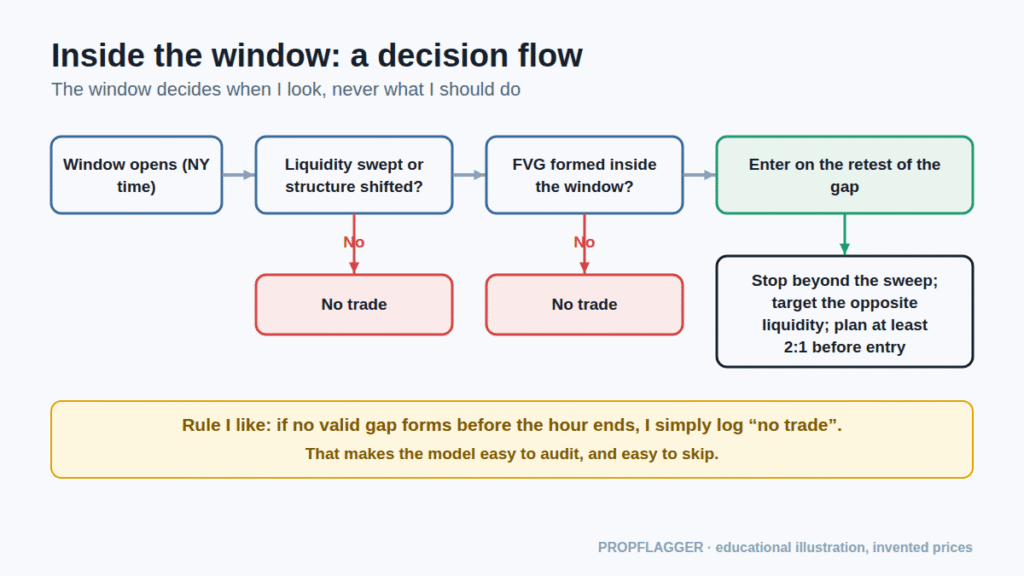
- Before the window: mark untapped session highs and lows and any unfilled imbalances on both sides.
- Inside the window: wait for a sweep of one marked level, or a clear structure shift.
- Look for the gap: I only consider a fair value gap created by displacement inside the window.
- Plan the trade: entry on the retest of the gap, stop beyond the sweep, target the opposite liquidity, and at least two to one on paper.
- If nothing valid forms, I log “no trade” and move on.
Why do I like the no-trade rule?
It protects me from forcing a trade because the hour is ticking. It also makes the model easy to test: a trade either met every condition inside the window or it did not. That is much cleaner than a model where “close enough” can be argued afterwards.
What do I worry about?
- Time-zone mistakes: daylight-saving dates differ, so I check the conversion on the day.
- Window mining: if I test many windows and keep the one that looks best, I am overfitting (see types of trading strategies).
- Costs and slippage: the windows coincide with fast markets, where fills can be worse than planned.
- NSE traders: the windows do not match Indian market hours, so any Nifty version is a new hypothesis.
How would I journal it?
For each window I log: date, window, whether a sweep happened, whether a gap formed, the entry, stop, target, result in R, and a “no trade” entry when nothing qualified. Counting the no-trade windows matters, because it shows how often the setup actually appears. Compare with the Judas Swing, which uses session opens instead of fixed hours, and read risk management before sizing anything.
Reminder: I make no claim or guarantee of profit or success from anything described here. Examples are invented or illustrative and real results will differ. If you choose to trade, you are responsible for your own decisions and risk.



1 comment