


No claims, no guarantees. These are my personal study notes, written for education. I am not claiming that this model works, that it is profitable or that it will work for you. Nothing here is financial advice, a signal or a recommendation to trade. Trading carries a substantial risk of loss, and most retail traders lose money. See the full disclaimer.
What are the Market Maker Buy and Sell Models?
This is the model I trust least and understand the least, which is why I gave it the highest complexity in my ICT research notes. The Market Maker Buy Model (MMBM) and Sell Model (MMSM) try to describe a whole price cycle in one picture, in five stages.
What are the five stages?
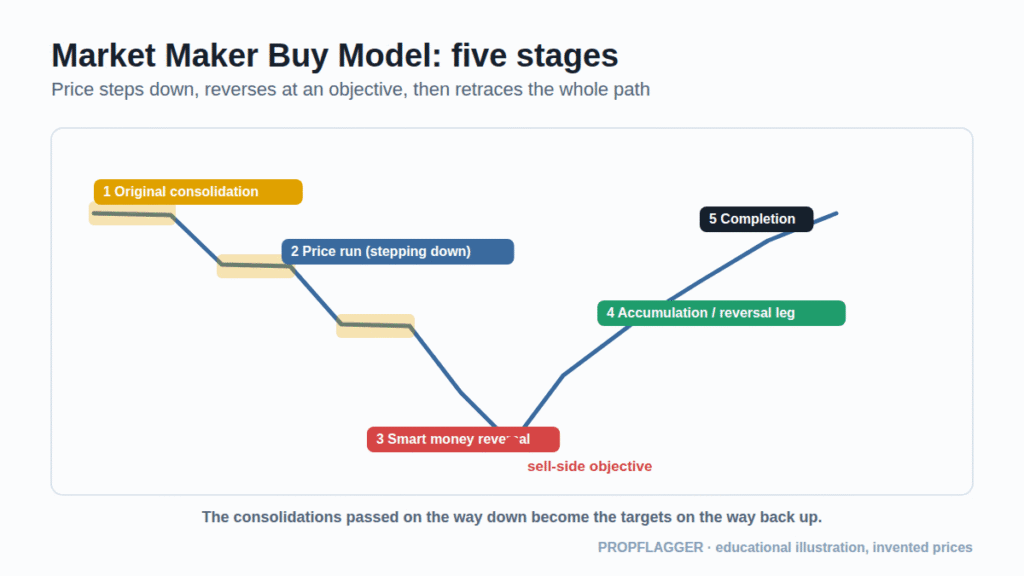
- Original consolidation: price ranges and builds a base.
- Price run: a move away from the range, taking liquidity on the way.
- Smart money reversal: price turns after the liquidity is taken, often with a structure shift (see market structure).
- Accumulation or distribution: the reversal leg builds, usually with pullbacks into gaps or order blocks.
- Completion: price reaches the opposite liquidity pool or the original range.
How is the sell model different?
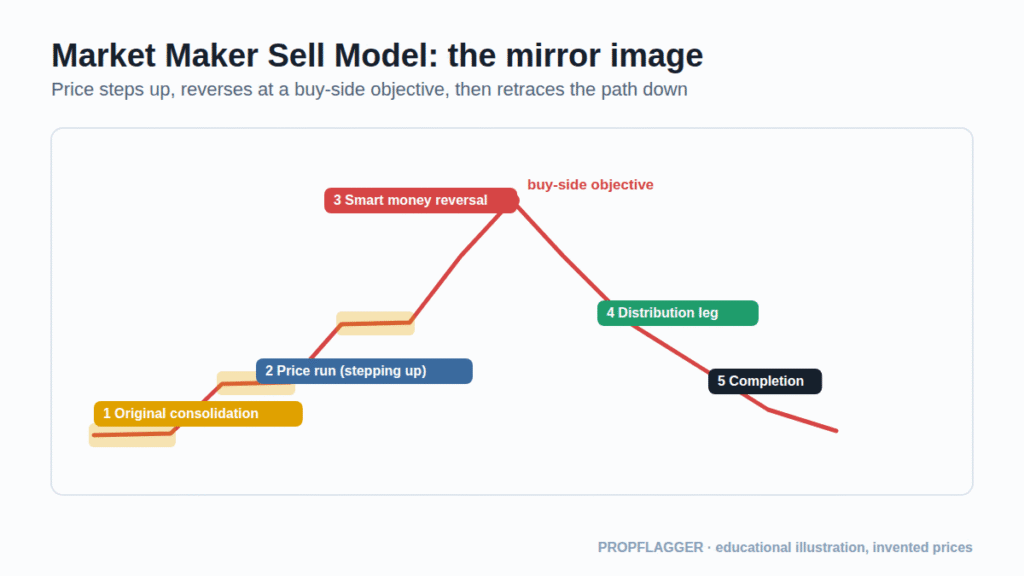
It is the same sequence upside-down: consolidation, a run higher into buy-side liquidity, a reversal, distribution on the way down and completion at lower liquidity. Anything I say about the buy model applies in reverse.
Where would I actually enter?
The model does not give entry rules itself. In the material I read, entries come from other models at stage three or four: a fair value gap, an order block or an OTE pullback. That is also why I see it as overlapping with the 2022 Model and Power of Three.
What are the weak points?
- Hindsight: the five stages are obvious on a finished chart and ambiguous while it is forming.
- Unfalsifiable: if price does something else, the stage can be relabelled.
- Unverifiable story: the “market maker” explanation cannot be seen on a price chart.
- Multi-timeframe: the stages can be drawn on several timeframes at once, and they can disagree.
How would I use it?
As a labelling exercise. I would mark the stages on past charts, write down what had to be true in advance, and only then ask whether the labels predicted anything. Any trade would use a rule from a simpler model, journaled with a yes/no checklist (see the journal guide).
Reminder: I make no claim or guarantee of profit or success from anything described here. Examples are invented or illustrative and real results will differ. If you choose to trade, you are responsible for your own decisions and risk.

2 comments