Trading Strategies

ICT Fair Value Gap (FVG) Entry Explained: The Three-Candle Imbalance

A fair value gap is the space between the wicks of candles one and three. I show how to draw it, where the 50% level sits and where the entry can fail.

ICT Fair Value Gap (FVG) Entry Explained: The Three-Candle Imbalance (featured illustration)

Quick answer

An ICT fair value gap (FVG) is a three-candle imbalance: the gap between the high of candle one and the low of candle three (bullish) or the reverse (bearish) after a strong middle candle. The entry idea is a limit order when price returns into the gap, often at the 50% midpoint called consequent encroachment, with the stop beyond the gap or the candle. A close through the gap can flip it into an inverse FVG. Nothing guarantees the gap holds.

Key takeaways

  • A FVG is the gap between the wicks of candle 1 and candle 3 around a strong candle 2.
  • The 50% level is called consequent encroachment (CE).
  • A close through the gap can turn it into an inverse FVG.
  • Gaps are very common, so context decides which are worth a plan.

No claims, no guarantees. These are my personal study notes, written for education. I am not claiming that this model works, that it is profitable or that it will work for you. Nothing here is financial advice, a signal or a recommendation to trade. Trading carries a substantial risk of loss, and most retail traders lose money. See the full disclaimer.

What is an ICT fair value gap?

The fair value gap is the building block I met first and use most when I label charts. It is model eleven in my ICT research notes, and it shows up inside others: the Silver Bullet, the 2022 Model and the Unicorn all rely on it.

How do I draw one?
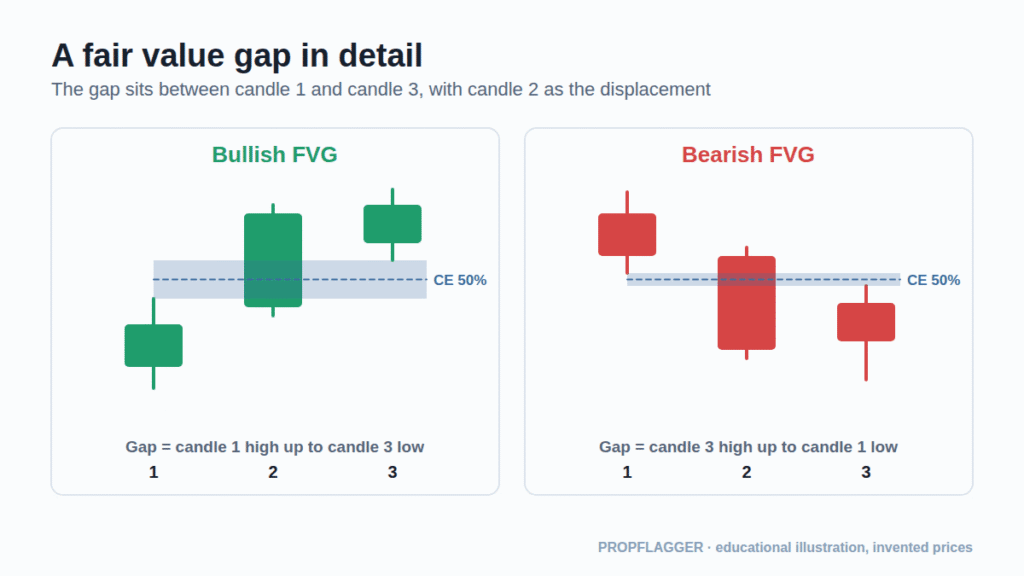
Three candle diagram showing the gap between the high of the first candle and the low of the third candle with the 50 percent consequent encroachment line
Anatomy of a bullish fair value gap.
  1. Find three consecutive candles with a strong middle candle.
  2. For a bullish gap, take the high of candle one and the low of candle three.
  3. If the low of candle three is above the high of candle one, the space between them is the gap.
  4. Mark the 50% midpoint, called consequent encroachment (CE).

A bearish gap is the mirror: the low of candle one above the high of candle three.

How would I plan an entry?
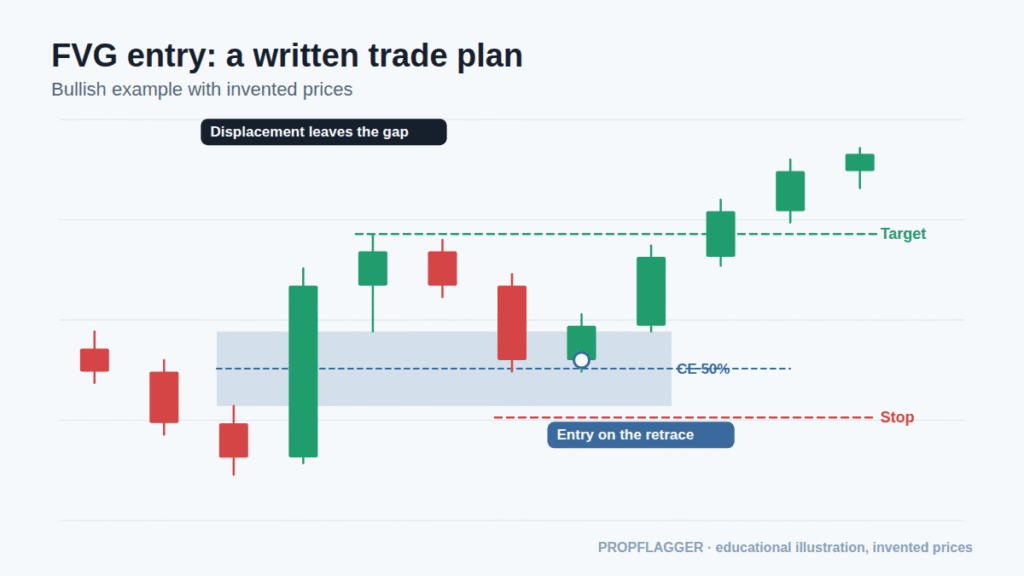
Trade plan chart with a limit entry at the fair value gap midpoint, the stop below the gap and the target at prior liquidity
An FVG entry plan with invented prices.
  • Entry: a limit order inside the gap, often at the CE.
  • Stop: beyond the gap or beyond the first candle’s extreme.
  • Target: the next liquidity pool (see liquidity).
  • Context: a gap left after a sweep and a structure shift (see market structure) is the one I would plan around.

What is an inverse FVG?

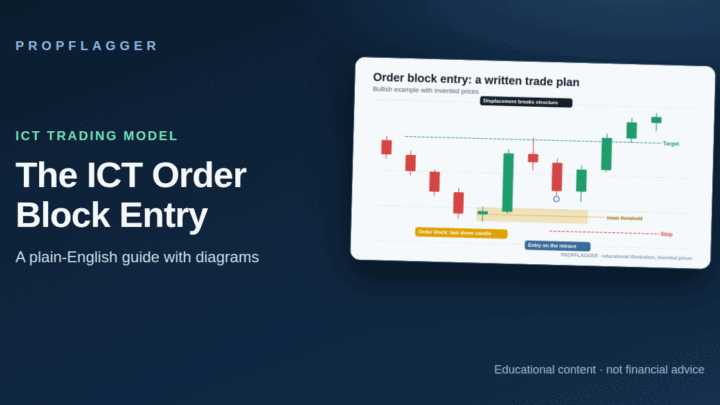
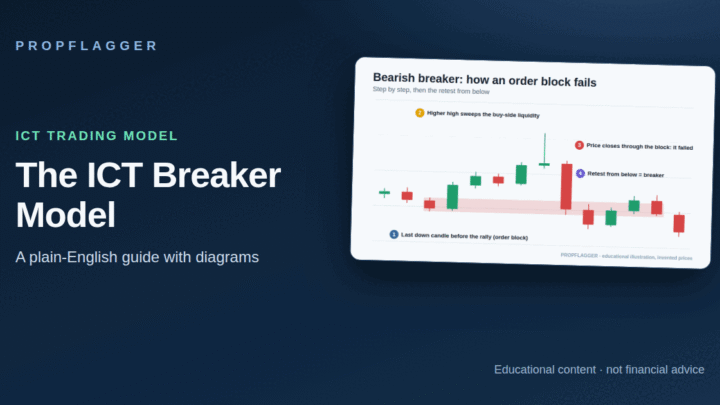
If price closes through a gap, some traders treat it as an inverse FVG (IFVG): the gap now acts from the other side. That is the same logic as a breaker block, applied to a gap instead of a candle.

How does it combine with other models?

  • Order block: a gap that sits on an order block narrows the zone.
  • OTE: a gap inside the 61.8%–79% band adds a second condition.
  • Unicorn: a gap overlapping a breaker.

What are the weak points?

  • They are everywhere: almost any chart has gaps, so a gap alone says little.
  • No guarantee of a return: price can run away and never revisit.
  • Timeframe dependence: a gap on 1 minute may sit inside a bigger one.
  • No independent data: I found no study on how often gaps hold.

How would I journal it?

Log the timeframe, the gap boundaries, the context (sweep, shift, session) and whether I entered at the CE or the edge, plus the result in R. Then compare gaps with context against gaps without. See the journal guide.

Reminder: I make no claim or guarantee of profit or success from anything described here. Examples are invented or illustrative and real results will differ. If you choose to trade, you are responsible for your own decisions and risk.
Key terms

FVG
Fair value gap, an imbalance across three candles.
CE
Consequent encroachment, the 50% midpoint of the gap.
IFVG
Inverse FVG, a gap that price closed through.

Frequently asked questions

What is a fair value gap in ICT?

It is a three-candle pattern where the wicks of candle one and candle three do not overlap, leaving a gap across the body of a strong middle candle. It marks an area where price moved fast with little trading.

How do I draw a bullish FVG?

Take the high of candle one and the low of candle three. If the low of candle three is above the high of candle one, the space between them is the bullish FVG. A bearish gap is the mirror.

What is consequent encroachment?

It is the 50% midpoint of the gap. Many traders use it as a precise entry or as the level that must hold.

What is an inverse FVG?

It is a gap that price has closed through. The idea is that it flips role, acting from the other side, much like a breaker.

Do all gaps get filled?

No. Gaps appear all the time and I found no independent data on how often price returns. That is why I would only plan a trade where context lines up.

Sources and further reading

  1. LuxAlgo library: Consequent Encroachment
  2. TradingView: Inverse Fair Value Gap (IFVG) idea
  3. BabyPips: What is ICT trading?

External links open in a new tab. They are provided for reference and are not endorsements.

The ICT models series

My research notes on twelve ICT models. Each guide stands alone and links to its neighbours.

  1. Overview: all 12 models
  2. 2022 Model
  3. Silver Bullet
  4. Judas Swing
  5. Power of Three
  6. Unicorn Model
  7. Turtle Soup
  8. OTE Model
  9. Market Maker Model
  10. Venom Model
  11. Breaker Model
  12. FVG Entry
  13. Order Block Entry

Last reviewed: . Written by the PropFlagger editor for education. Diagrams use invented prices. Nothing here is financial advice or a recommendation to trade.

Tags:

4 comments

Join the discussion

Your email address will not be published. Required fields are marked *

Comments are moderated. Please do not post trade signals, tips, links to paid groups, or claims of guaranteed returns.