

Trading Strategies

ICT Breaker Block Model Explained: When an Order Block Fails

A breaker is an order block that failed and is retested from the other side. I explain how it forms and what makes it different from a plain order block.

ICT Breaker Block Model Explained: When an Order Block Fails (featured illustration)

Quick answer

An ICT breaker block is an order block that failed: price sweeps liquidity, breaks through the block and shifts structure, and the old block is then retested from the other side. The entry is at or near the breaker, with the stop beyond it and confirmation from a market structure shift. It is a way of labelling a failed level, and nothing guarantees the retest holds.

Key takeaways

  • A breaker is a failed order block that is retested from the opposite side.
  • It needs a sweep and a structure shift, not just a broken level.
  • Entry is at or near the breaker; the stop goes beyond it.
  • It is the building block of the Unicorn model.

No claims, no guarantees. These are my personal study notes, written for education. I am not claiming that this model works, that it is profitable or that it will work for you. Nothing here is financial advice, a signal or a recommendation to trade. Trading carries a substantial risk of loss, and most retail traders lose money. See the full disclaimer.

What is an ICT breaker block?

I think of a breaker as an order block that lost an argument. The block was supposed to hold; instead, price ran through it, and now the same candles are being retested from the other side. It is model number ten in my ICT research notes.

How does a breaker form?
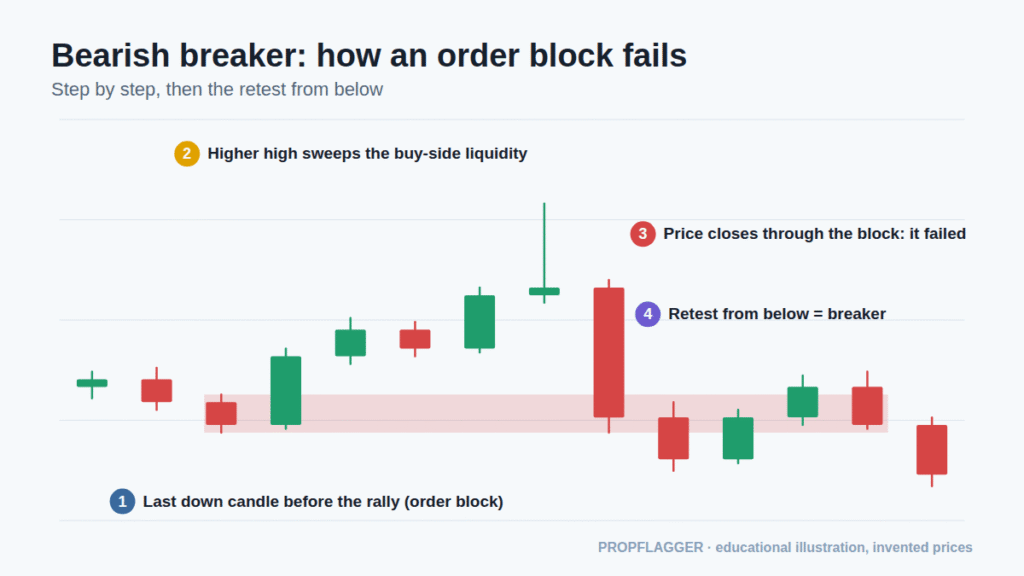
Chart showing a bullish order block failing, price breaking below it and the old block being retested as a bearish breaker
How a bearish breaker forms (invented prices).
  1. An order block forms (for example a bullish one before a rally).
  2. Price takes liquidity beyond a swing (see liquidity).
  3. Price breaks through the block and shifts structure (see market structure).
  4. The old block is retested from the other side. A failed bullish block becomes a bearish breaker, and a failed bearish block a bullish one.

How is it different from an order block?
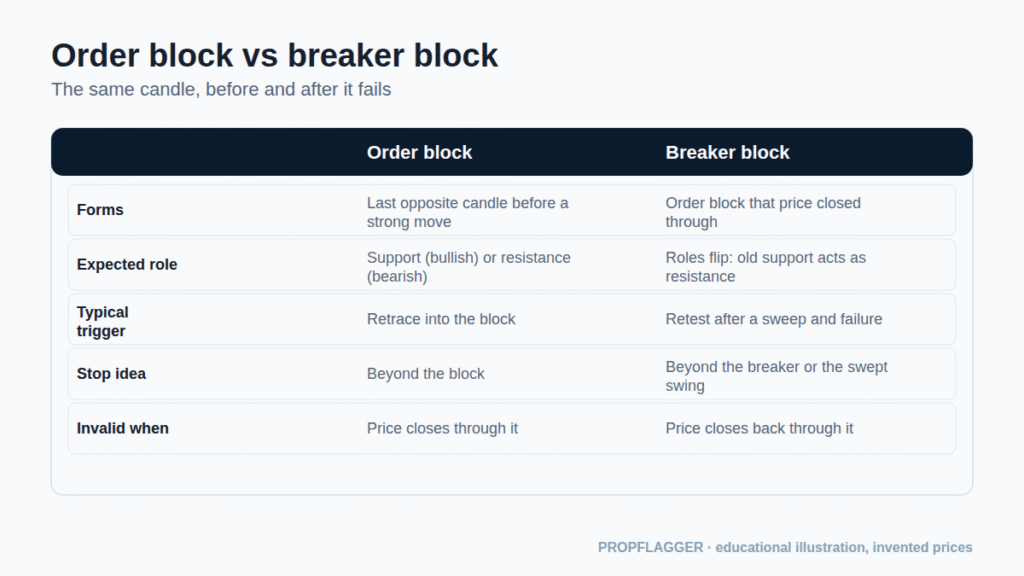
Side-by-side diagram comparing an order block that holds with a breaker block that has failed and flipped
Order block versus breaker block.

An order block asks price to bounce. A breaker only exists because price did not. That is the only reason I treat them as separate models: the story and the entry direction are opposite.

How would I plan an entry?

  • Entry: a limit order at or near the breaker, or after a lower-timeframe shift as confirmation.
  • Stop: beyond the far edge of the breaker.
  • Target: the next liquidity pool or swing.
  • Size: from the stop distance (risk management).

When a breaker overlaps a fair value gap, the combination is the Unicorn Model.

What are the weak points?

  • Which candle is the block? Teachers draw it differently, so the zone moves.
  • Retests can fail: a breaker can be broken again.
  • Naming confusion: “breaker” and “mitigation block” are used inconsistently.
  • Hindsight bias: failed blocks are easy to spot after the fact. See price action.

How would I journal it?

Record the original block, the sweep, the structure break, the breaker boundaries, the entry and stop, and a pre-entry screenshot. Compare breaker entries with plain order block entries from the same period (see the journal guide).

Reminder: I make no claim or guarantee of profit or success from anything described here. Examples are invented or illustrative and real results will differ. If you choose to trade, you are responsible for your own decisions and risk.


Key terms

Order block
The last opposite candle before a displacement.
Breaker
An order block that failed and now acts from the other side.
MSS
Market structure shift: a close through the last swing.

Frequently asked questions

What is an ICT breaker block?

A breaker block is an order block that failed. Price breaks through it, usually after a liquidity sweep and a structure shift, and the old block is then used as a level from the other side.

What is the difference between an order block and a breaker?

An order block is expected to hold and push price away. A breaker is a block that did not hold, so the same candles now act as resistance (after a bullish block fails) or support (after a bearish block fails).

How do I trade a breaker?

As described, wait for the sweep and structure shift, then plan a limit entry at the breaker, place the stop beyond it and target the next liquidity pool. Confirm with a lower-timeframe shift before entering.

What is the difference between a breaker and a mitigation block?

Some teachers use the terms differently. In the sources I read, a breaker follows a sweep and a break of the structure, while a mitigation block does not take liquidity first. Definitions vary, so write yours down.

Does the breaker model work?

I cannot say. I found no independent test, and a failed block can fail again, so I would test it myself with fixed rules.

Sources and further reading

  1. LuxAlgo library: Breaker Block
  2. Backtrex: ICT breaker block guide

External links open in a new tab. They are provided for reference and are not endorsements.

The ICT models series

My research notes on twelve ICT models. Each guide stands alone and links to its neighbours.

  1. Overview: all 12 models
  2. 2022 Model
  3. Silver Bullet
  4. Judas Swing
  5. Power of Three
  6. Unicorn Model
  7. Turtle Soup
  8. OTE Model
  9. Market Maker Model
  10. Venom Model
  11. Breaker Model
  12. FVG Entry
  13. Order Block Entry

Last reviewed: . Written by the PropFlagger editor for education. Diagrams use invented prices. Nothing here is financial advice or a recommendation to trade.

Tags:

5 comments

Join the discussion

Your email address will not be published. Required fields are marked *

Comments are moderated. Please do not post trade signals, tips, links to paid groups, or claims of guaranteed returns.